
I started writing a diary at the beginning of the year. So far, I’ve written 239 entries, totaling over 100,000 words (not including my book notes). In addition to this, I rate my mood every day.
If you ask what the biggest change has been after writing a diary for so long, I’d say my emotions have become more stable.
In the past, whenever I felt down, I couldn’t pinpoint the cause or understand why it was affecting my mood.
Writing it down makes everything better.
You might ask, “I don’t know where to start.” I didn’t either at first, but I made myself write, even if it was just a single word.
For example, I would write one word “DOWN” Once you start with the first word, you feel an impulse to continue. Why am I down? Did something happen? Who made me feel this way, and what are they like? What can I do to feel less agitated? Questions follow one after another, and naturally, so do the answers.

My Obsidian Vault
If you really don’t know what to write, set up a few question templates for yourself. When you don’t feel like writing, just ask yourself these questions:
“What was the happiest thing that happened to me today?”
“What was one thing that made me sad today?”
“Is there anything I didn’t finish today that I want to continue tomorrow?”
Whether or not you feel the urge to continue after writing the first word, the act of “writing” itself can make you less anxious. You can think of yourself as a pool. If you only pour water in (input) without letting any out (output), problems will surely arise. There are many forms of output, such as writing or speaking. The key is to find a method that suits you and adjust in a timely manner to keep the water in the pool balanced.
The mood curve feature came about because my husband said my mood swings were really drastic, with one or two times a month where my whole being would just be listless. I really wanted to figure out what was going on, so I added this feature. Strangely enough, my scores are now consistently around 5 (out of 5). Every evening when it’s time to rate my day, I quickly review what happened. Even if I had an argument with my partner in the morning or had a frustrating day at work, I still give it a 5.
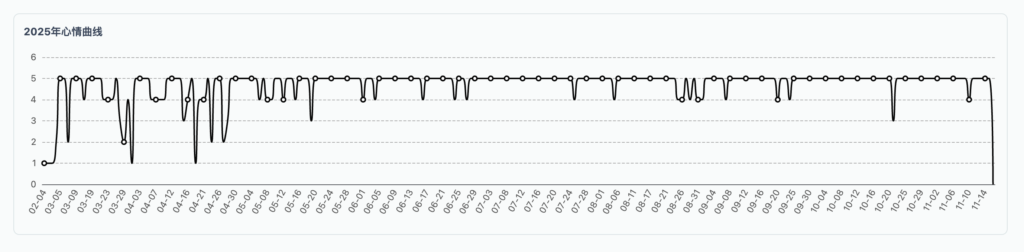
My mood
Isn’t this just deceiving myself?
At the end of the day, ask yourself, “Were you happy today?” “Were you fulfilled today?” and you’ll know whether you’re deceiving yourself. Thinking back, it seems that what happened during the day really wasn’t a big deal. Plus, I write down everything that happens in a day—the cause, the process, the result, and my feelings. As you write, the feelings just dissipate. Acknowledging the existence of negative emotions allows us to see more clearly what our ideal self looks like and what I should do to become that ideal “them.”
I remember a famous positive psychology experiment from Harvard University. The experiment divided participants into several groups and had them review and record their best or worst experiences of the day. A month later, researchers found that the participants who wrote down or spoke about their bad experiences showed significant improvement in their psychological state. This experiment powerfully demonstrates that processing and expressing emotions through the act of “writing” is a very effective form of self-healing.
Besides writing frequently,
you must also write without obstruction
Don’t worry about what tools you use, whether the stickers are pretty, if your handwriting is neat, or if the logic of your writing is coherent. Just one word: Write. As you keep writing, you’ll get it right. When you have an idea, you must output it immediately; don’t set up any barriers. For example, I often start my creations on the subway, just by opening the Notes app on my phone and starting to write.
Writing a diary is a form of self-healing. Words you dare not say, words no one listens to, words you can’t express clearly—write them all down. But some might think, isn’t this just “escapism”? I thought so too at first, feeling that I didn’t dare to confront others and could only hide in my own little space to write, away from the light.
In reality, this is just an ordinary person’s ordinary journey of growth. There’s no need to worry.
The journey of growth is separate from the act of writing. We all have times when we don’t want to talk, or we’re too lazy to explain things to others, feeling like nobody understands us and we don’t want to understand anyone either. As you gain more experience, you’ll find that even those harsh words can be seen as a unique and interesting perspective on the world. After all, everyone lives in a different world. Visiting someone else’s world occasionally can be refreshing. You will eventually have a day when you can “let your thoughts fly,” so don’t be anxious and think of this as “escapism.”
A diary is a tool to assist your growth; don’t treat it as a last resort for self-healing. Otherwise, you can easily get trapped in your difficulties, feeling that even writing cannot save or heal you, and that journaling is just a lie, a deceptive trick. As I mentioned earlier, a person is like a pool, and you must constantly adjust your state to keep the water balanced. When you feel that journaling isn’t helping, try going for a walk or hiking a mountain, and then come back and try writing again. Or, you could even write in your diary, “What kind of crappy method is writing? It doesn’t work at all, I still feel bad…”
I originally only planned to write 200 words, just to share the benefits of journaling. I didn’t expect to write so much for so long.
I hope you have a good day, every day.

P.S. The writing tool used is Obsidian. The word count and diary entry count are from the Components plugin. You can find it by searching for "Components" in the Obsidian community plugins. Note, this is a paid plugin.
If you want to read more about my article, you can click here.