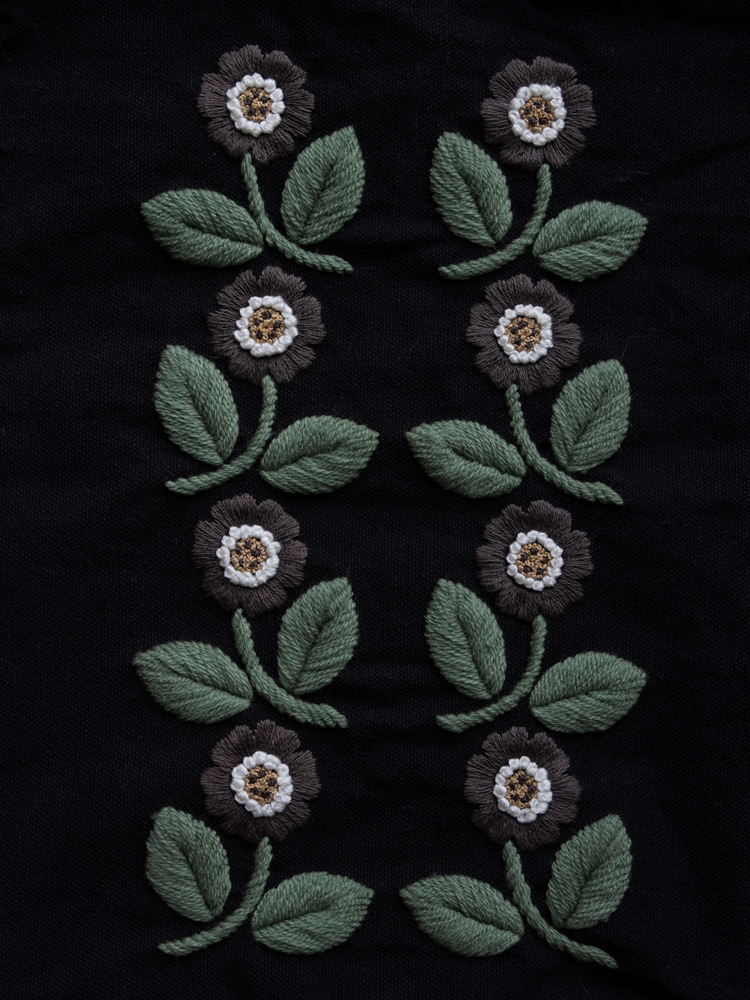
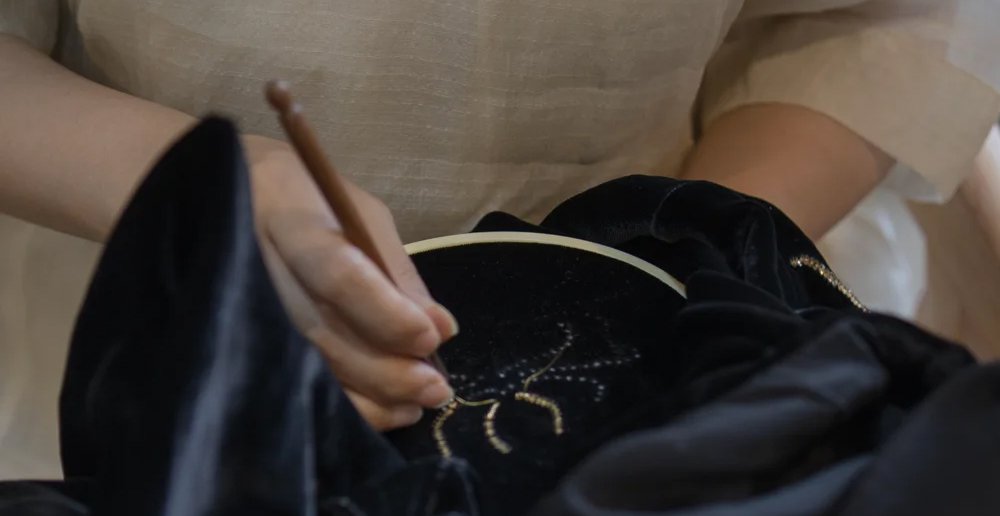
All the work we’re creating is just a manifestation of a source that’s flowing through us. It becomes a book, a movie, an architectural structure, a painting, a meal, a business—whatever we make it into, it comes from this source.
— Rick Rubin
These words from Rick Rubin’s The Creative Act: A Way of Being resonated with me on a profound level. Before reading them, I’d always seen creation as an act of pure invention—something we “think up” or “make up.” Whether writing a passage, sketching an image, or embroidering a flower, I instinctively claimed these works as my own, born from the confines of my mind.
But Rubin proposed a radical alternative: the creator is not the source, but the channel. We aren’t inventing from a vacuum; we are receiving, translating, and transmitting a greater energy. This perspective prompted me to reconsider the very meaning of “creation” and my role within it.
So, Who Is Really Creating?
If creation were a purely individual act, why do certain ideas transcend time and culture, emerging in different people across the globe?
Consider the “Three Hares” motif. It’s a beautifully simple yet dynamic design of three rabbits chasing each other in a circle, their ears joining in the center to form a triangle, with each rabbit appearing to have two ears while only three are depicted in total. What’s astonishing is that this pattern appears not only in the Dunhuang Caves of China but also on stained-glass windows in English churches and in Islamic art from the Middle East. These regions were separated by vast distances, and cultural exchange at the time was limited. Yet, they independently gave birth to a nearly identical design.
While some research suggests the motif’s spread is linked to the Silk Road, its true origin remains a mystery. I only stumbled upon this fascinating cross-cultural connection when I posted my embroidery piece, The Three Hares, on a Reddit forum. Until that moment, I had no idea the pattern had such deep, sprawling roots.
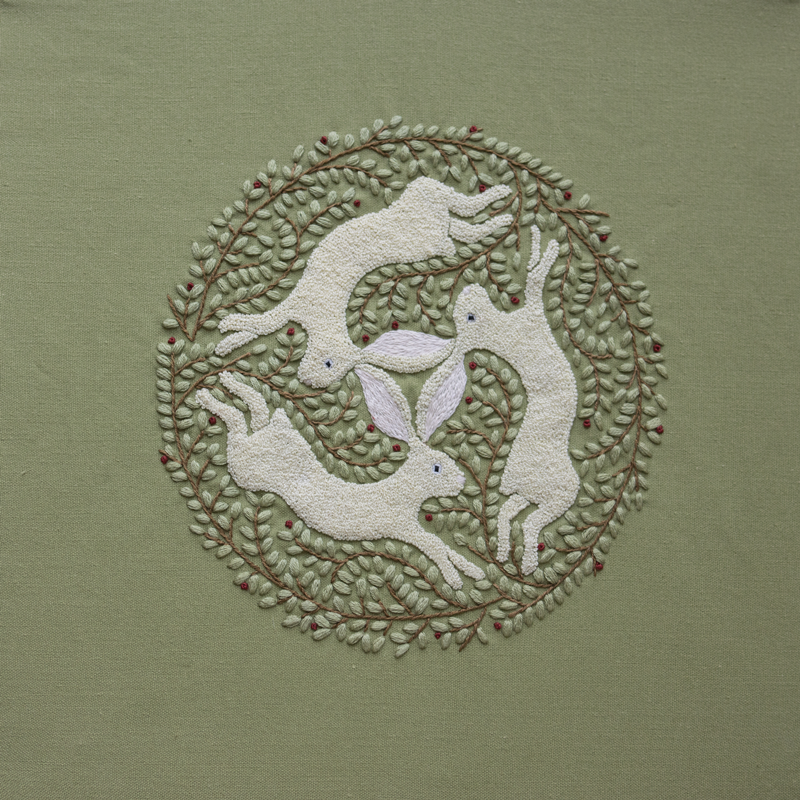
The Three Hares, 2022. LissyLuo
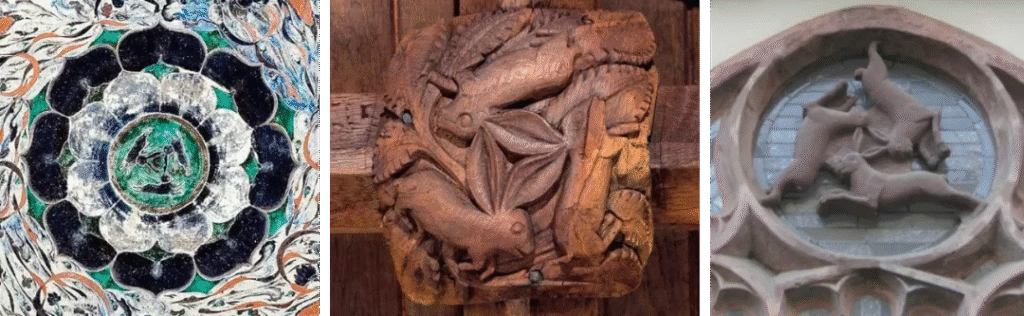
Left: The caisson ceiling of Cave 407, Mogao Caves, Dunhuang.
Center: A wood carving of the Three Hares motif in a church in Devon, England.
Right: The Dreihasenfenster (The Three Hares Window) in Paderborn Cathedral, Germany.
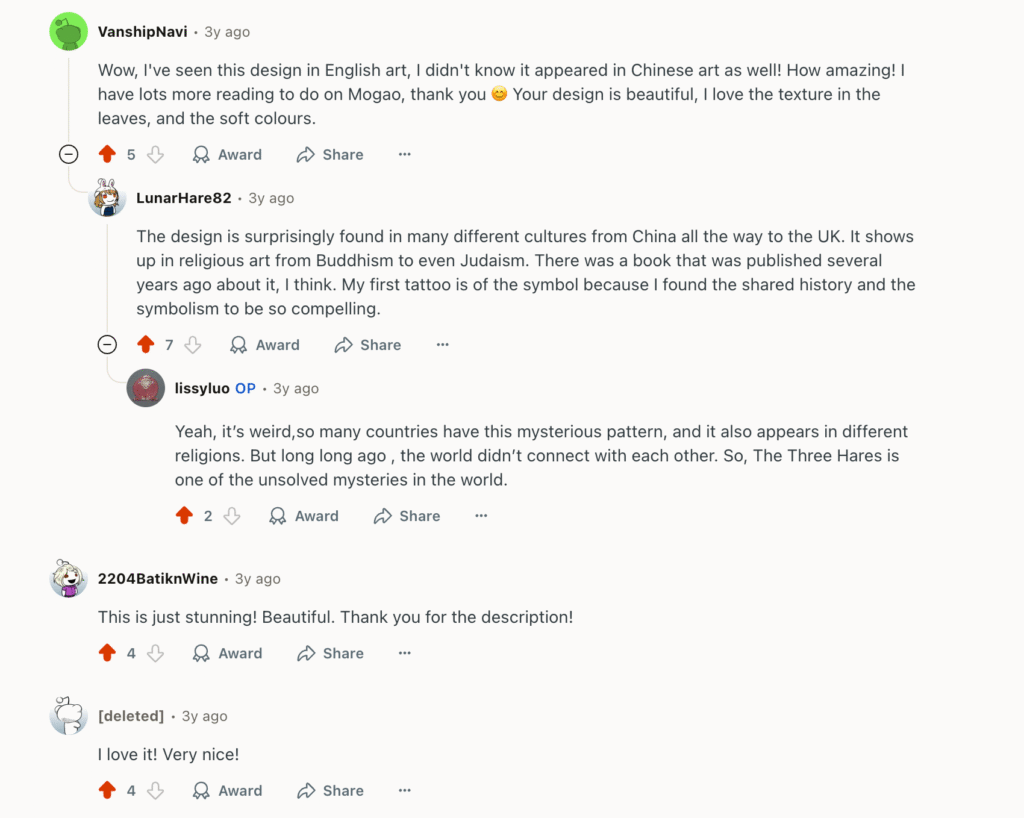
A discussion on the r/Embroidery subreddit following the author’s post,
revealing the motif’s cross-cultural history.
You can explore the original conversation [here].
Music has its own strange echoes. Paul McCartney recalled that the melody for “Yesterday” came to him in a dream one morning in 1964. He woke up, immediately played it on the piano, and spent weeks playing it for friends, asking if they’d heard it before. He was worried he had subconsciously plagiarized it. The fact that no one could identify its origin doesn’t diminish the power of his initial fear—the melody felt so familiar, as if it had already existed somewhere in the ether.
These examples gently dismantled my old beliefs. Perhaps the force of creation doesn’t originate entirely from within us. Perhaps it is a larger intelligence expressing itself through us. As Rubin suggests, certain ideas exist in a “source,” waiting for the right moment to be expressed through different people.
If you have an idea you’re excited about and you don’t bring it to life, it’s not uncommon for the idea to find its voice through another maker. This isn’t because the other artist stole your idea, but because the idea’s time has come.
— Rick Rubin
Maybe we aren’t the masters of our creations. Maybe we are finely tuned receivers, vessels for the thoughts of the universe. This understanding didn’t just change how I see my art; it changed how I see my relationship with the world. We are not isolated creators; we are points of connection in a vast, flowing current.
We Are Simply the Medium
If creation is the expression of a broader force, what role do we play?
This brings to mind the Tibetan Epic of King Gesar, a heroic saga that has been passed down for over a thousand years, primarily through oral performance. Among its many performers, there is a special class known as the “bards of divine revelation” . They claim their ability to recite the epic was not learned but bestowed upon them by deities. This awakening is often preceded by a mystical experience—a profound dream in childhood, a vision during a high fever. It’s said that some, even illiterate teenagers, can awaken one day and flawlessly recite millions of words of the epic. It’s a phenomenon that science has yet to fully explain.
Even in fiction, this idea resonates. In the movie Avatar, the Na’vi connect to the Tree of Souls, Eywa, which holds the collective consciousness and memories of their ancestors. By connecting to Eywa, they can hear the voices and feel the thoughts of their entire planet. In a way, this concept of a collective consciousness mirrors Rubin’s idea that creativity flows from a greater “source.”
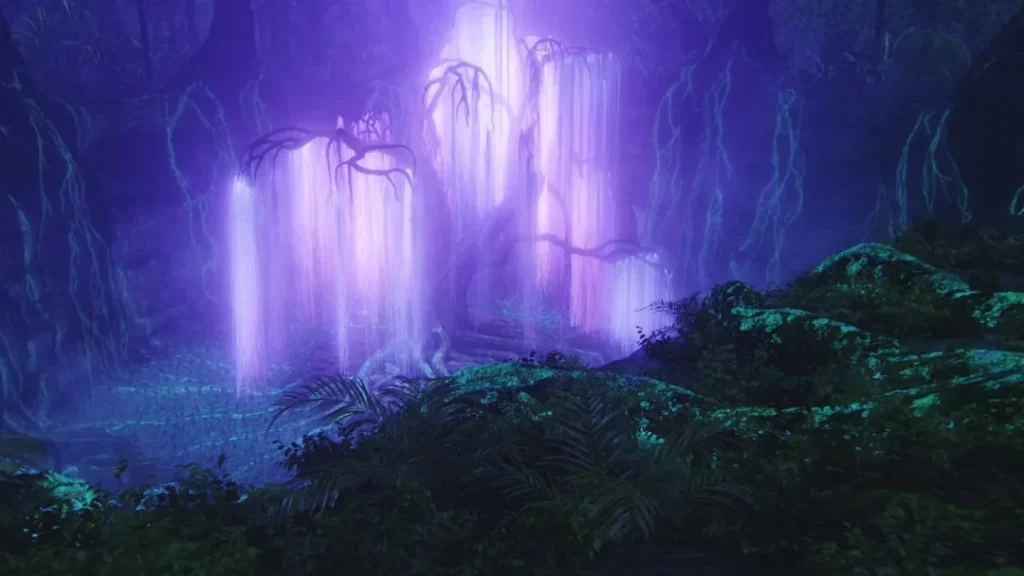
The Tree of Souls from the film Avatar (2009).
Is it possible that our ideas are not truly our own? That they are simply flowing through us, using us as a conduit? Like the wind in the mountains, invisible but carrying the scent of the seasons. Like a river, unconscious yet holding the memory of the earth it has traveled. Perhaps we are not the authors, but simply the medium—a temporary station for ideas and inspiration to pass through on their way into the world.
What, Then, Is Creation?
When we see creation as an act of transmission rather than invention, its essence becomes clearer.
It’s not just about turning a thought into a tangible form. It’s a process of connection—linking with a larger force, a collective memory, a universal consciousness. The universe itself is in a constant state of creation. We, as part of it, participate in our own ways: we build bridges, write songs, design products. These seemingly disparate activities all stem from the same fundamental act: receiving and expressing something from the “source.”

A flower spotted on the trail / LissyLuo
Perhaps creation isn’t about starting from scratch. It’s about awakening and recording what already exists. It’s as natural as a tree bearing fruit. The artist is simply the medium that allows this energy to flow. When I pick up my needle and thread, maybe I’m not creating something new, but capturing a thought that already exists somewhere, giving it shape and texture in my own unique way.
But this raises a question: if creation is a process of receiving, how do we open ourselves up to these signals from a higher frequency?
How to Let Inspiration Find You
Rubin’s answer is not to search or predict, but to create an open space where these formless ideas can flow through us naturally.
To do this, we must cultivate the open-minded curiosity of a child. Children perceive the world’s magic so easily because they aren’t constrained by adult frameworks. They live in the present, fascinated by every leaf, every ray of sunlight. This pure sensitivity is the wellspring of creativity.
Think back to the last time you truly felt the world around you. For me, it was on a hike. I glanced at a flower and was struck by its beauty. Logically, I knew it was the same species as the ones planted outside my office building, but this one felt different. This was the moment of inspiration for my piece, [More Than A Flower(2025)]. It was as if, because I gave it a second glance, it seized the opportunity to whisper, “Hey, come closer. I have something to tell you.” In that moment, I was open, and so I could hear its voice.
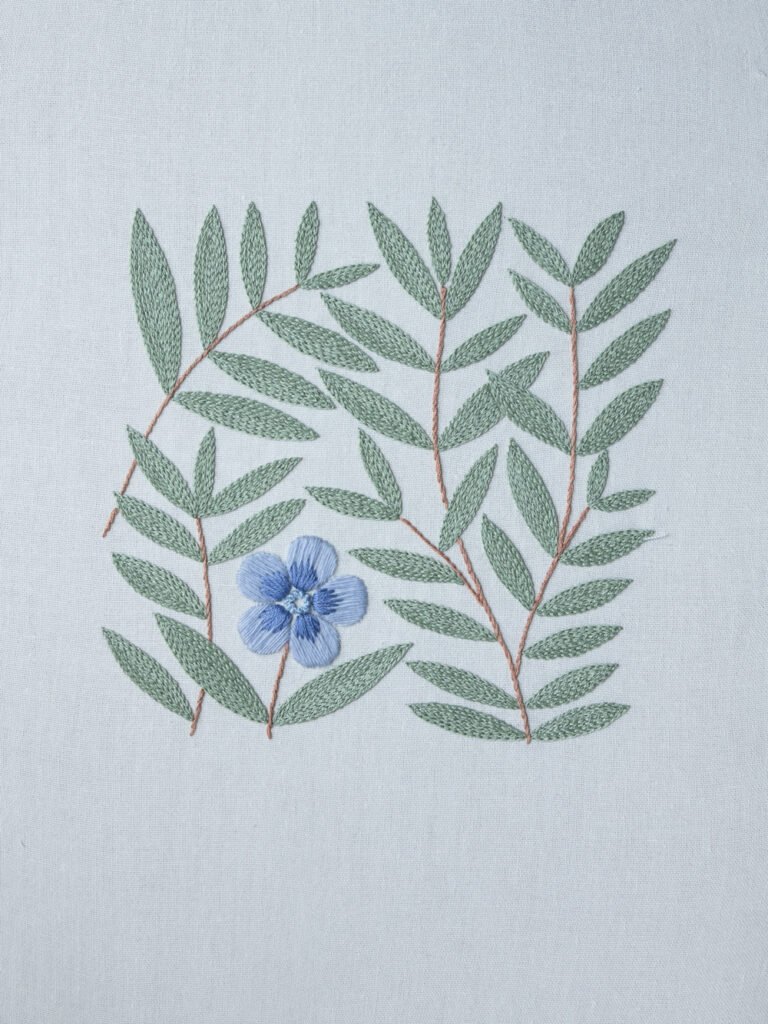
More Than a Flower,2025,LissyLuo
Those moments that make you stop and hold your breath are often when you are closest to inspiration. They remind us that inspiration isn’t found through striving; it finds us when we let go of our attachments and simply are.
This state is difficult to pursue intentionally. As Rubin says, we can’t define or capture the signals, but we can create a vacuum to attract them. When you empty your mind of the desperate need to “come up with something,” you create space for what’s hidden deep inside to surface.
So, the answer to how we find inspiration might be beautifully simple: observe, listen, and feel. Let the world flow through you. Let it happen. Become a clean canvas, and wait for the universe to leave its gentle mark.
A specific idea is not available until a particular time. And when that time comes, it finds a way to express itself through us.
— Rick Rubin
Ironically, as I write these very words, inspiration feels more distant than ever.
It can be felt, but never forced.
I’m Just the Messenger
So if one day you tell me,
“Hey, I met that flower too, and it told me the same thing,”
I will believe you.