In the culture I grew up in, we’re trained to look for “the standard answer.”
I don’t think this is uniquely Chinese. Every society has scripts, and every school system rewards certain kinds of correctness. Even in more individualistic cultures, you can still feel the pull of “the safe path,” and the fear of getting it wrong.
But where I’m from, that pressure can be unusually explicit. There are clear formulas for what counts as “right,” and you’re praised for following them. Standard answers feel safe and predictable, like insurance against mistakes.
The problem is what happens after school ends.
Once you step into the wide-open field of life, do you still have the courage to step outside the circle? Or do you realize you’ve been standing inside a circle someone else drew for you?
For a long time, I didn’t notice how much I depended on that certainty, until a cup of coffee (made with fewer tools and looser rules) tasted better than the “perfect” one.
A “correct” recipe, and a cup that still felt wrong
16 grams of coffee. 92°C water. A 2-minute-30-second extraction.
I followed a “perfect” pour-over formula like a lab protocol for almost a year. Every morning looked like a chemistry experiment. I measured the grams, watched the temperature, timed the pour. The logic was simple: if I did it “right,” it would taste “good.”
As a beginner, I genuinely didn’t know what “good” meant. Copying the pros felt reasonable. Their methods probably wouldn’t lead me too far astray. And yet, my results were strangely consistent in the worst way.
I would ask Mr. Ding to taste my carefully brewed coffee. He would look confused. I would feel defeated. A perfect lose-lose situation. Nobody got spared.
Eventually, I had to ask myself a more honest question. Was I chasing universally good coffee, or the kind of coffee I actually like?
When I stopped being precise, the coffee got better
After we moved to Shenzhen, we simplified everything.
I brought only a server, a dripper, a hand grinder, and a kettle without temperature control. Last month, Mr. Ding broke the server. So the already minimal process became even more minimal.
The grinder holds about 20 grams (I measured it back when we lived in Chengdu), so now I just scoop roughly that amount each time. The kettle has no display, so I go by feel: boil the water, let it sit for a bit, then pour. Without a server to swirl and mix, I stir the coffee with chopsticks.
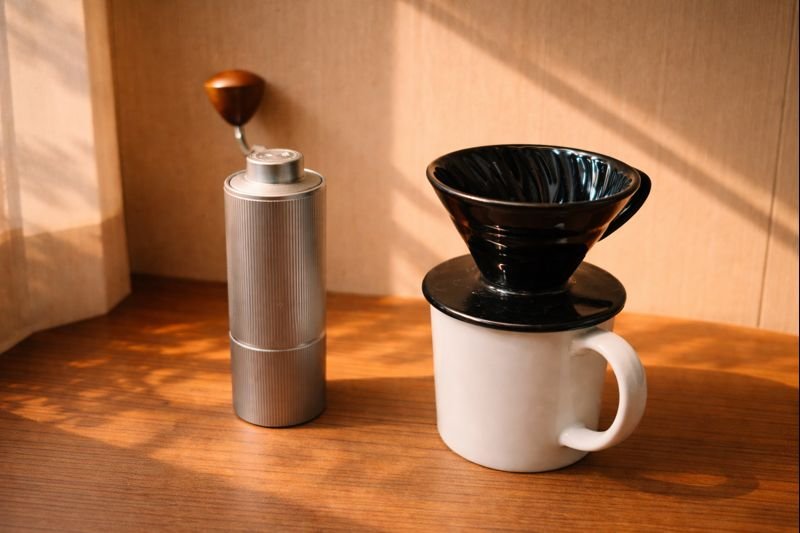
My pour-over coffee gear
It’s imprecise. A little sloppy, even.
And yet, I was surprised by how good the coffee became. Maybe yesterday’s harsh bitterness made today’s richer cup feel even better. Or maybe those professional tools and strict parameters were giving me something else entirely.
Not better coffee, but the safety of certainty.
When those tools were cut away, I suddenly saw how much I had been leaning on them. And how little of it was essential.
I’m not claiming “non-standard” is always better. I’m not denying the value of professional parameters. I’m only asking this.
Can we allow ourselves to find what fits our current conditions, and what we personally enjoy?
From coffee to life: letting the “standard answer” loosen its grip
What I keep returning to is simple.
Parameters offer options. People make choices.
At first, I thought I only wanted to allow “non-standard answers.” Now I think I want something bigger. I want to allow all answers to exist.Maybe in the future I’ll genuinely prefer coffee extracted at a lower temperature, with a hint of bitterness. That’s not “wrong.” It’s a choice.
Parameters don’t make the choice. People do.
In many ways, we run our lives the same way I used to make coffee.
Follow the route our parents hand us. Study hard. Get into a good university. Find a stable job. Get married. Have kids. Raise them. Retire.
It’s a recipe society has already written. A “safe extraction formula.” A burden parents carry in the name of responsibility.
Right after I got married, my family started urging me to have a child. At first I argued with my parents. Everyone got heated. Nobody convinced anyone. Later, I realized what we were really doing. Two different “standard answers” were colliding.
It felt like me insisting Mr. Ding drink my carefully brewed coffee, while he insisted I drink the tea he made with “proper technique.” Both of us thought we were offering the “right” thing, “for your own good.” But the result was the same as before: more pain, no real gain.
There’s a line from the Dao De Jing that returns to me often:
「明白四达,能无知乎?」
“Even when your mind is clear and you understand things from every direction, can you avoid leaning on cleverness, can you stay humble, and not turn what you know into something you show off or wield?”
— Laozi, Dao De Jing
So do I keep arguing? Who is right? Who is wrong?
Maybe this isn’t a right-or-wrong question. Maybe it’s a question of balance.
Allow different answers to exist. Don’t stand above people and assume their choices are flawed. But also don’t let others take the steering wheel of your life.
Friends around me are making different choices. Some follow their parents’ advice and marry at the “right age.” Some choose to stay single. Some decide not to have children. Everyone is negotiating their own balance, trying to brew the cup of coffee that tastes “good” to them.
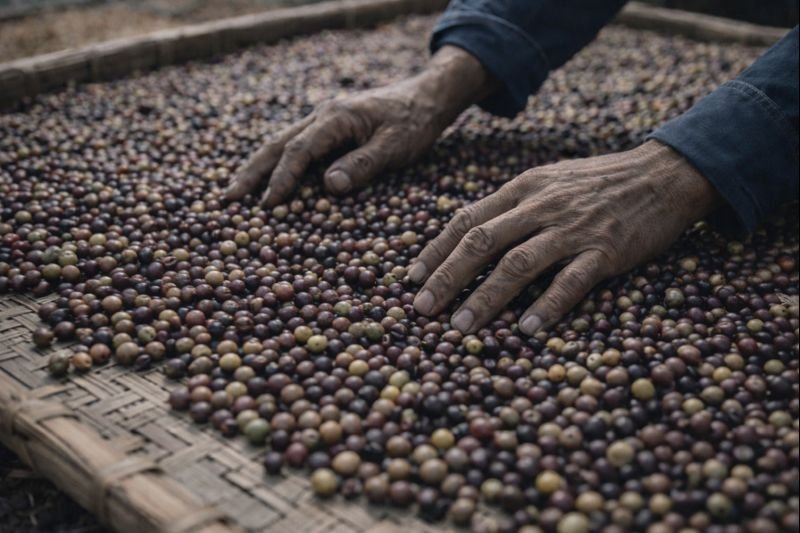
One day, Mr. Ding said to me, “Let’s go to rural Yunnan sometime and find coffee beans dried by farmers.”
“Can beans that look ugly really taste good?” I asked.
He said, niche means surprise. Standard means less risk, fewer mistakes, but also, more ordinary.
Surprise or ordinary, both are just personal definitions of “good.” Everyone’s standard is different. What if I simply like “ordinary”?
The only question that matters is whether it’s my choice.
What kind of coffee do you want today? ☕️
If this resonated, you might enjoy a few more notes from me. [Click Here]