Lately, my husband and I have been lost in a survival game called Don’t Starve. And I’ve noticed he has a peculiar obsession: farming. Even late in the game, with several refrigerators overflowing with food that we can’t possibly eat before it spoils, he remains devoted to the endless cycle: planting, harvesting, watching the crops rot, and turning them into fertilizer for the next batch.
At first, I saw it as just a quirk of the game. But then I picked up a book by the great Chinese sociologist Fei Xiaotong, From the Soil (《乡土中国》), and everything clicked into place. I realized that for Chinese people, this love for the land transcends mere survival. It’s a cultural gene etched into our very bones, an instinct so profound that it surfaces even in a virtual world. My partner’s in-game compulsion was a miniature reflection of a vast, real-world cultural truth. In his book, Fei masterfully sketches how this identity was formed.
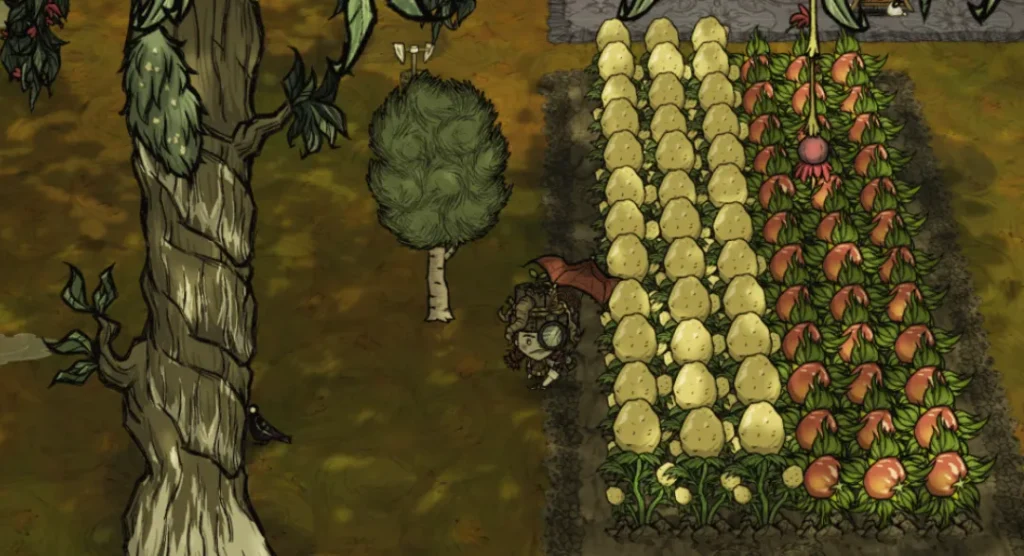
My husband’s digital harvest in the game Don’t Starve.
Planted in Place: The Roots of an Agrarian Soul
It all begins with the soil. Our civilization was born along the great rivers, whose waters nourished the earth and gave our ancestors their first taste of a stable harvest. On this damp, fertile ground, they put down roots. Agriculture became their way of life. But unlike nomadic herding or hunting, farming doesn’t allow you to follow the water and grass. It plants you, like a tree, firmly in one place. The land that nurtures you also confines you. It is both our making and our undoing. This immobility is the key to understanding China’s agrarian society. As Fei notes, even cataclysmic events like war could barely shake this deep-rooted tradition of staying put.
大旱大水, 连年兵乱,可以使一部分农⺠抛井离乡;即使像抗战这样大事件所引起基层人口的流动,我相信还是微乎其微的。
Droughts, floods, and years of war may force some farmers to leave their homes; but even an event as monumental as the War of Resistance [WWII] caused, I believe, a negligible flow of population at the grassroots level.
— Fei Xiaotong, From the Soil
Of course, this “immobility” wasn’t absolute. When the pressure to survive became too great, people were forced to leave their homeland in search of a new life. Fei calls this a “spillover.”
这些宣泄出外的人,像是从老树上被⻛吹出去的种子,找到土地的生存了,又形成一个小小 的家族殖⺠地,找不到土地的也就在各式各样的运命下被淘汰了,或是“发迹了”。
These people who spill over are like seeds blown from an old tree. Those who find soil survive and form a small family colony. Those who don’t are eliminated by fate in various ways, or they “make their fortune.”
— Fei Xiaotong, From the Soil
For those who remained, they naturally gathered in villages for safety and to lower the cost of living. When a village consists of the same familiar faces for centuries, it becomes what Fei calls a “society of acquaintances”—a world without strangers. In such a place, order isn’t maintained by black-and-white laws, but by a set of unwritten, deeply understood rules of “rites and customs” (礼俗, lǐsú). This code is invisible, yet omnipresent. It might manifest as the village gossip surrounding a divorced woman, or a family’s insistence that not having children is the ultimate act of filial impiety.
In the past, looking at these customs from my urban perspective, I found them absurd. I would even argue with my family about them. But after understanding the logic that grew from the soil, I see that it’s not a simple matter of right or wrong. These are two entirely different survival codes, evolved by two different kinds of societies to maintain their own coherence.
The Unbreakable Tether
Reading Fei’s work, I realized this “from-the-soil” essence has never left me. It lives in the daily habits of my loved ones. My father often says that when he retires, he’ll go back to our hometown, get a plot of land, and grow vegetables. My aunt, who has lived in the city for years, has turned her rooftop into a lush, green garden, a little patch of farmland in the sky. This yearning for cultivation seems to have detached itself from the physical necessity of land; it has become a pastoral dream, a spiritual anchor, no matter where one is.
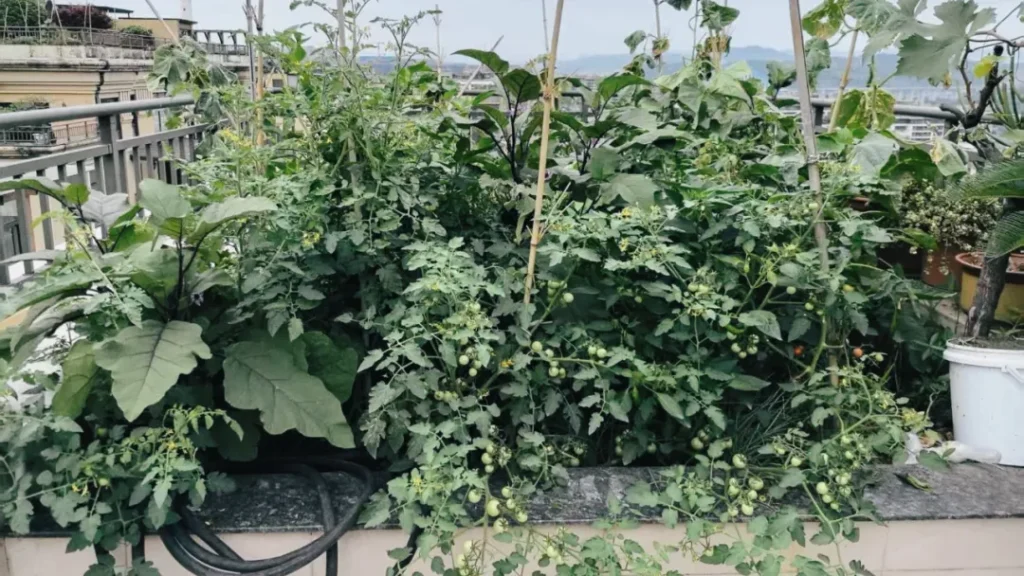
my aunt’s vegetable garden on her rooftop.
This connection sometimes appears as an unbreakable tether. I think of my late grandmother. Even after our family’s financial situation improved, she insisted on staying in the countryside, raising a few chickens and growing vegetables she would bring to us. When she traveled, her body might be among mountains and rivers, but her heart was always back home, worrying if someone was feeding her chickens.
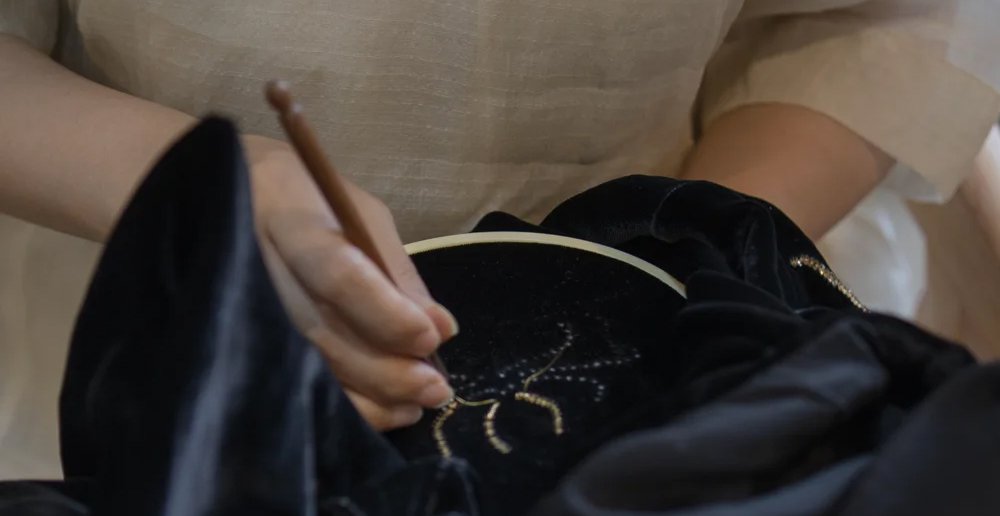
But the story that moves me most is my other grandmother’s. To this day, she still weaves bamboo steamers, the kind that sell for less than a dollar. Our family doesn’t need the income, but she continues her work, day after day. The process is laborious—from my grandfather hauling home giant stalks of bamboo, to splitting the reeds, to polishing them smooth—yet they never seem to think of stopping. Those steamers are no longer tools for a livelihood; they are their way of being in the world, a habit that transcends economic reason. It’s just as Fei described: “to follow the custom is to follow one’s heart” (从俗即从心, cóng sú jí cóng xīn). When you’ve repeated an action your entire life, it ceases to be labor. It becomes life itself, the very source of your peace.
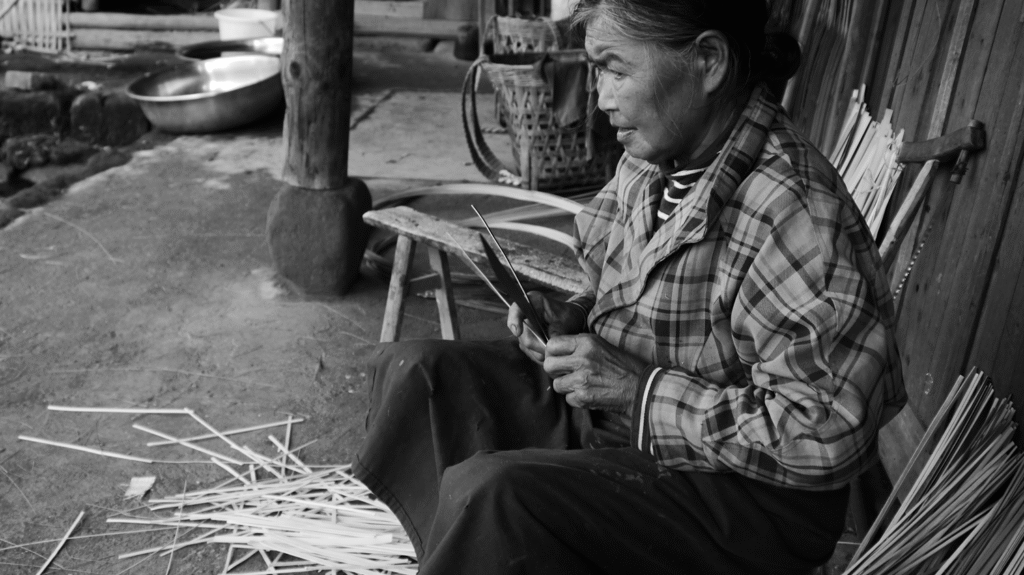
The skilled hands of my grandmother, splitting bamboo into fine strips for weaving / Photo by Lissyluo
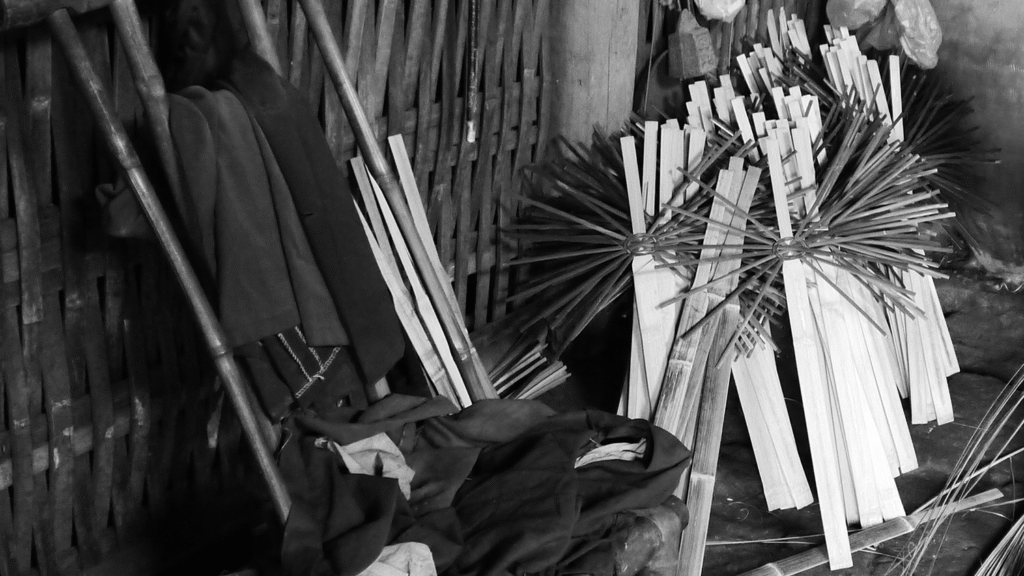
A bamboo noodle basket in the making / Photo by Lissyluo
These stories from my own family show me how the cultural DNA of agrarian China has been passed down through the simplest, most humble daily routines. It might seem a bit “earthy” (土气, tǔqì), a bit out of step with the times, but it also forms the most resilient and warmest foundation of our emotional world.
Our Making and Our Undoing
And yet, this very foundation is often casually labeled as “old-fashioned” or even “backward” in today’s world. So how should we view it?
Perhaps the answer lies not in a simple judgment of “good” or “bad,” but in that paradox I mentioned earlier: the land is both our making and our undoing. Fei Xiaotong captured this perfectly:
从土里⻓出过光荣的历史,自然也会受到土的束缚,现在很有些⻜不上天的样子。
A glorious history grew from the soil, so naturally it is also bound by the soil. Now, it seems we are having some trouble taking flight.
— Fei Xiaotong, From the Soil
Our “Making”: For millennia, this deep bond with the land was the optimal solution for survival. It fostered stable communities and nurtured a brilliant civilization. It traded mobility for security, building a cultural foundation that has lasted for thousands of years. My grandmother’s seemingly “outdated” persistence was, in its time, the very bedrock that supported our family. Her daily toil bought more than just food; it bought my father his only chance to leave the soil—an education. In an era of wearing straw sandals on bare feet in winter and sleeping under borrowed quilts, that opportunity was a luxury paid for with unimaginable sweat and hardship.
Our “Undoing”: But when society undergoes a seismic shift from an agrarian to a modern commercial one, those former strengths can become shackles that keep us from “taking flight.” An attachment to the land can become a slowness to embrace new opportunities. The personal connections of an acquaintance society can clash with the rule-based systems of a society of strangers. And that rustic “earthiness” becomes a synonym for “backward” in the face of ever-changing urban life.
This makes me think of every trip back to my hometown, where the “greetings” from my aunts and uncles are a barrage of questions: What were your exam scores? Which university? Where do you work? Are you married? Have you had kids? For someone used to city life, this feels deeply intrusive. But this mismatch isn’t anyone’s fault. In their world, this is a standard, polite way of showing they care. In my world, respecting personal boundaries is the kindest greeting of all.
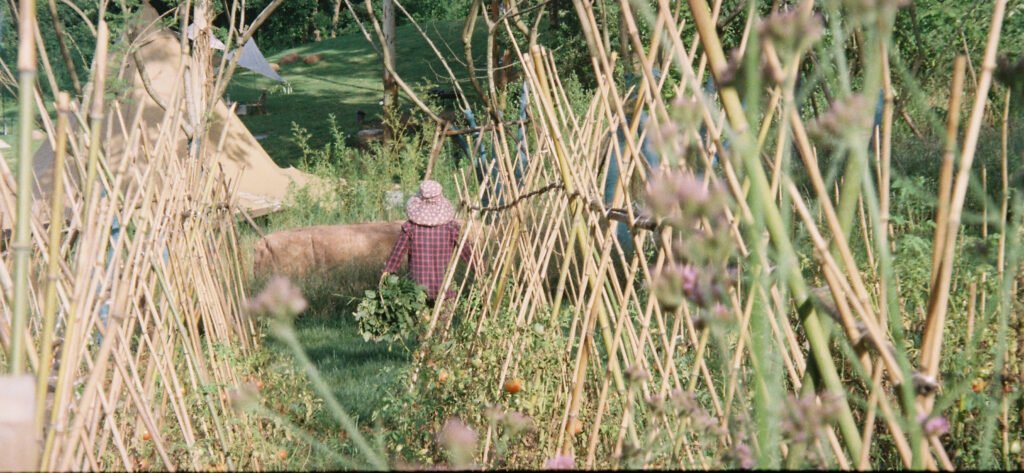
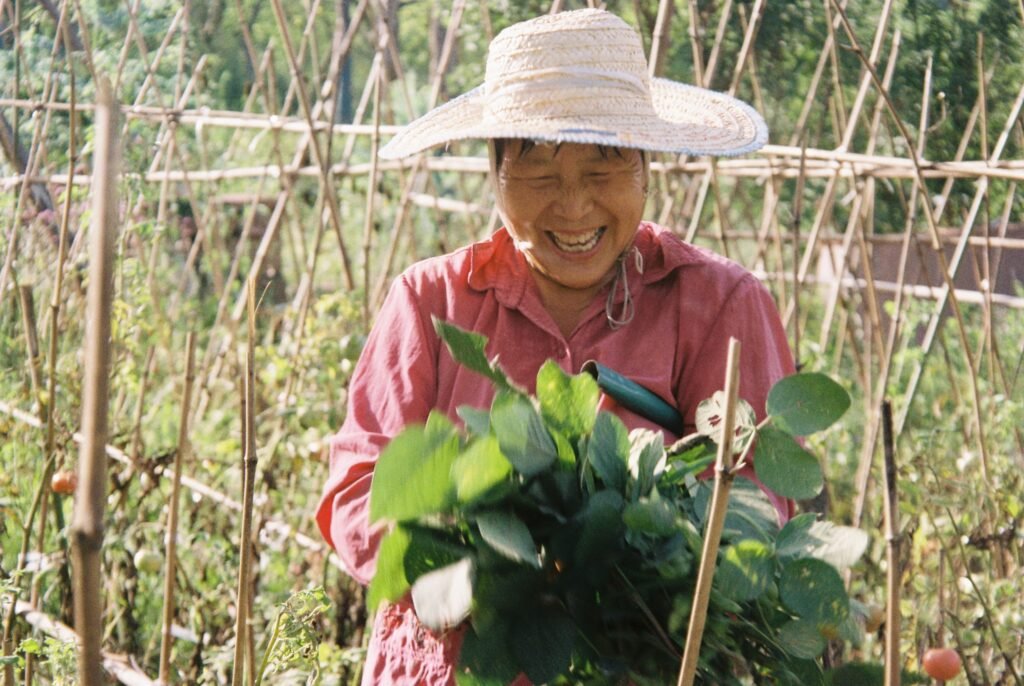
A chance encounter with an elder, tending her vegetable patch / Photo by Lissyluo
So, rather than debating its merits, I prefer to see this agrarian mindset as a survival strategy. Any strategy exists to solve a specific problem in a specific environment. It’s neither good nor bad, only fitting or unfitting. The way of life in rural society was the best answer our ancestors could give to the question, “How do we survive?” We cannot use today’s exam to grade yesterday’s paper.
The Clash of Two Worlds: Rites vs. Rules
This clash between the “caring” inquiries of relatives and our cherished “personal boundaries” reveals the fundamental difference between two social structures, which Fei Xiaotong identifies as the “Society of Rites” and the “Society of Law.”
The Society of Rites is our agrarian China. It’s a “society of acquaintances,” where people are “born into” relationships through blood and geography, not “brought together” for a specific purpose. Here, the code of conduct is “rite” (lǐ), a tradition and habit internalized in the heart. The entire community shares a single, stable, and clear set of values. The question “Who am I?” is never asked, because the answer is given to you: “I am my father’s daughter, a member of this village.” Following this shared custom brings inner peace.
The Society of Law is our modern metropolis. It’s a “society of strangers,” where relationships are often functional. We gather for a common goal (like a job), and we disperse when it’s done. Society is held together by explicit, universal laws and contracts. Here, the single “grand custom” is shattered, replaced by “countless small customs”—an infinite menu of lifestyles, career paths, and values to choose from.
This shift has granted us unprecedented individual freedom. We are no longer bound by a single standard and can define our own lives. But this freedom comes with a profound modern ailment: the paradox of choice and an identity vacuum.
Freedom’s Paradox and Finding My Way Home
When anything is possible, we often don’t know what to choose. Every choice means abandoning all other possibilities, which creates immense anxiety. “Who am I?” transforms from a non-issue into the ultimate question that everyone must answer, yet few can. To escape the burden of this freedom, many of us “huddle together for warmth,” joining small groups with clear rules—a hobby club, a fan community. By following these “small customs,” we find a temporary patch for our identity vacuum.
It’s like a traveler who doesn’t know their destination. Instead of studying a map or consulting their own heart, they just jump on a bus where all the other passengers look happy. They’ve surrendered the right and responsibility of choosing their destination in exchange for the false certainty of being “on the way.”
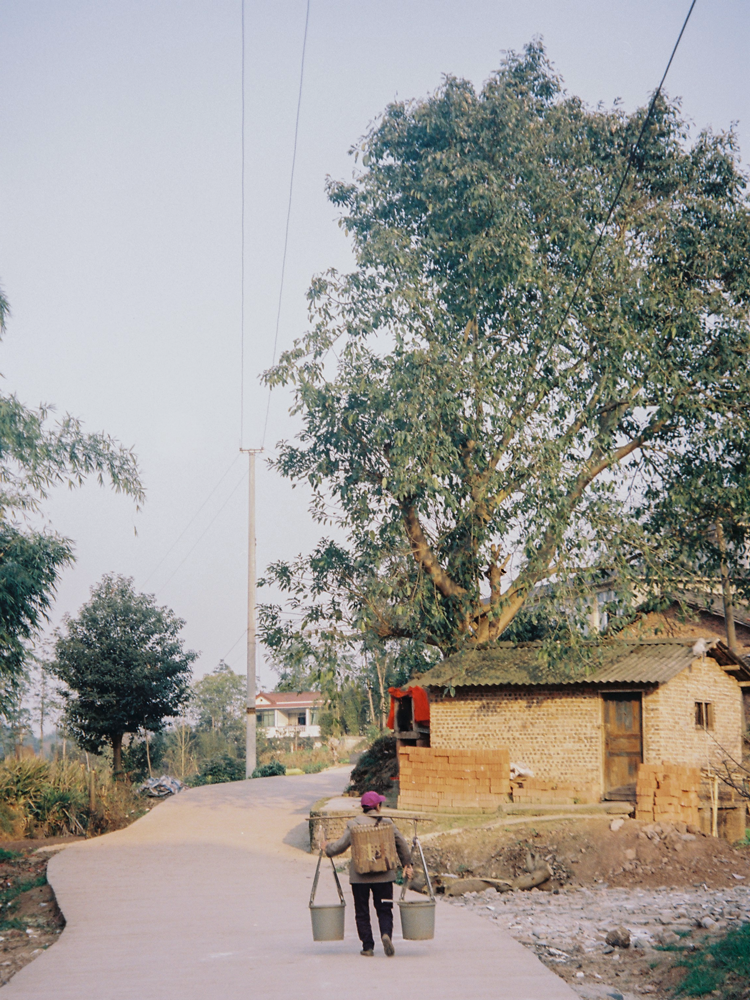
On the road to my grandmother’s home / Photo by Lissyluo
The Society of Law allowed us to step off the single dirt path of our ancestors, to escape a fate of no choices. We saw a wider world, but in doing so, we took on the heavy burden of defining “who I am.”
I don’t have the answer to that question yet. Maybe I never will. But I do know my destination. It is to return to being that “earthy” person from the countryside.